Key Takeaways
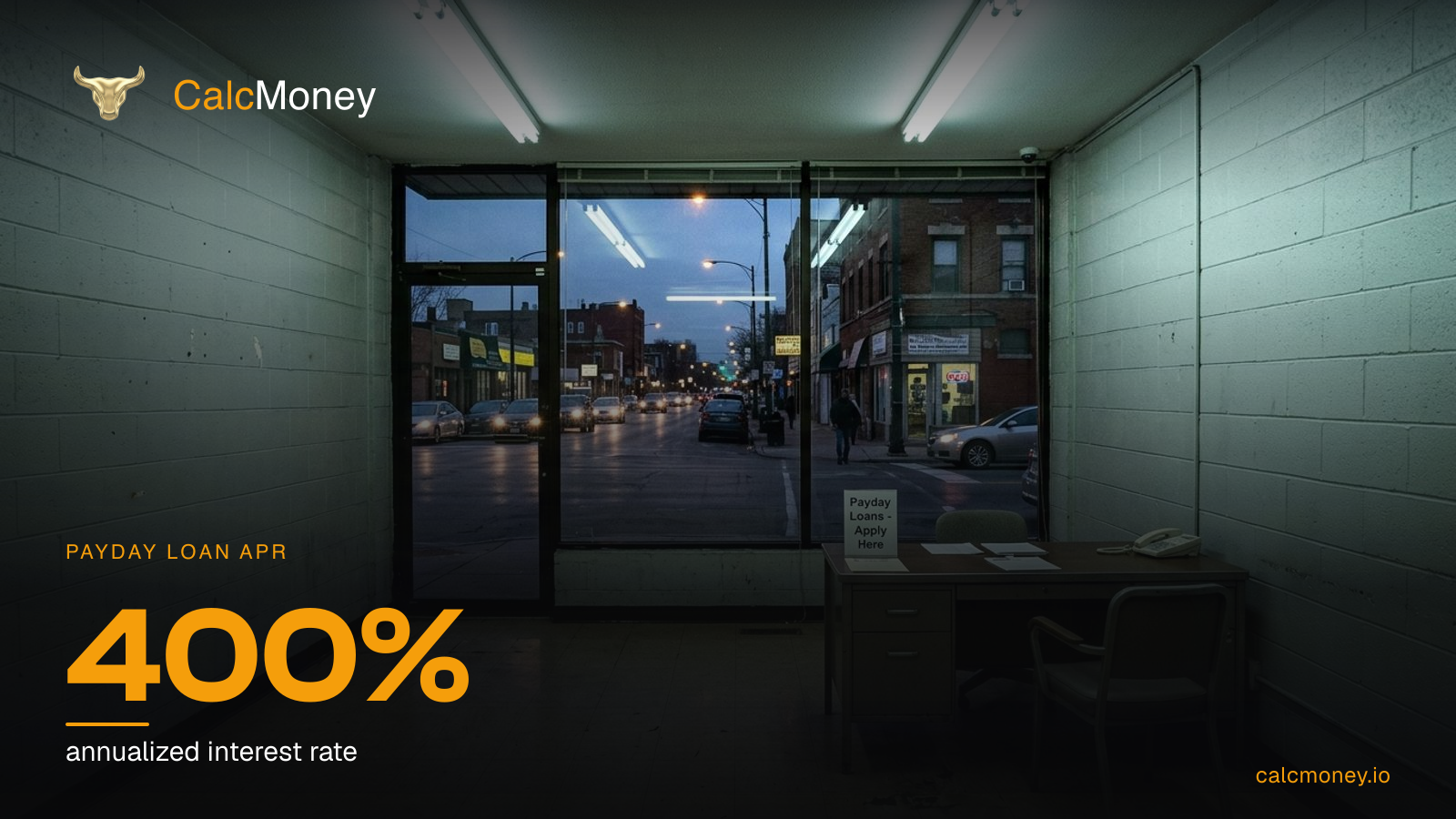
- The average payday loan carries a 391% APR, according to the Consumer Financial Protection Bureau.
- Rollovers are the real trap. Rolling a $300 loan over four times costs $240 in fees alone, on a loan that never grew.
- Convert any payday fee to APR using one formula: APR = (Fee / Loan Amount) x (365 / Loan Term in Days) x 100.
- Tool: Model your payoff timeline with the Debt Snowball Calculator →
Lower Your Interest Rate NowSPONSORED
If your cards are charging 20%+ APR, consolidate into one lower-rate personal loan.
What a Payday Loan Actually Costs
Payday lenders quote fees, not interest rates. That framing is intentional. "$15 per $100 borrowed" reads like a flat service charge. It is not. It is an interest rate expressed in a way that obscures its magnitude.
The standard payday loan term runs 14 days, tied to the borrower's next paycheck. Apply the annualization formula and the picture changes immediately.
The APR Formula:
APR = (Fee / Principal) x (365 / Loan Term) x 100
For a $100 loan with a $15 fee, repaid in 14 days:
APR = (15 / 100) x (365 / 14) x 100 APR = 0.15 x 26.07 x 100 APR = 391.07%
A 30-year fixed mortgage currently runs near 7%. A credit card averages 21.47% APR as of early 2026. A payday loan at 391% sits in a different category entirely.
The Rollover Trap: Where the Real Damage Happens
The CFPB reports that 80% of payday loans roll over or are renewed within 14 days. Borrowers who cannot repay on the due date pay another fee to extend the loan. The principal stays constant. The cost compounds.
Worked Example 1: The Single-Cycle Borrower
- Loan amount: $300
- Fee: $15 per $100, so $45 total
- Loan term: 14 days
- Repayment: $345 on day 14
APR calculation:
APR = (45 / 300) x (365 / 14) x 100 APR = 0.15 x 26.07 x 100 APR = 391.07%
This borrower pays $45 for 14 days of access to $300. The fee represents 15% of the principal for two weeks of use. Annualized, that rate exceeds the average credit card by a factor of 18.
Worked Example 2: The Four-Time Rollover Borrower
Same $300 loan. This borrower cannot repay in full on day 14. They roll the loan over four consecutive times.
| Rollover | Fee Paid | Cumulative Fees | |----------|----------|-----------------|| | Initial | $45 | $45 | | 1st | $45 | $90 | | 2nd | $45 | $135 | | 3rd | $45 | $180 | | 4th | $45 | $225 |
After 10 weeks (70 days), this borrower has paid $225 in fees. They still owe $300. Total cost of the loan at final repayment: $525. They paid 75% of the principal in fees alone before retiring the debt.
Annualized cost over the full 70-day period:
APR = (225 / 300) x (365 / 70) x 100 APR = 0.75 x 5.21 x 100 APR = 391.07%
The annualized rate does not change. The damage scales with time.
How to Convert Any Payday Fee to APR
Lenders are legally required to disclose APR under the Truth in Lending Act. Many borrowers miss that disclosure or do not locate it on the loan document. Running the calculation independently takes under 60 seconds.
Step 1. Identify the total fee charged on the loan. This is the dollar amount due above the principal.
Step 2. Divide the fee by the loan principal. This gives the periodic rate.
Step 3. Multiply by 365, then divide by the loan term in days. This annualizes the rate.
Step 4. Multiply by 100 to express as a percentage.
Three Common Fee Structures, Annualized
| Fee Per $100 | Loan Term | APR |
|---|---|---|
| $10 | 14 days | 260.71% |
| $15 | 14 days | 391.07% |
| $20 | 14 days | 521.43% |
| $15 | 30 days | 182.50% |
A 30-day loan at $15 per $100 looks materially better. It is still 182.50% APR, more than eight times the average credit card rate.
State Caps and What They Actually Mean
Eighteen states and the District of Columbia cap payday loan rates at 36% APR or lower, effectively banning the traditional payday loan product. In those states, lenders either exit the market or operate under installment loan structures with lower stated rates.
The remaining 32 states permit triple-digit APR payday loans. Some states apply fee caps that translate to APRs near 300%. Others impose no meaningful rate ceiling.
Knowing your state's cap matters for one reason: it establishes the floor. A lender operating at the state maximum is not offering a competitive rate. They are charging as much as the law allows.
If your state permits 400% APR loans and a lender quotes you 350% APR, that is not a good deal. It is a slightly less expensive version of an expensive product.
The Comparison That Changes the Decision
Most payday borrowers are not choosing between a payday loan and a mortgage. The realistic alternatives deserve direct cost comparison.
Scenario: You need $300 for 14 days.
| Option | Total Cost | APR |
|---|---|---|
| Payday loan ($15 per $100) | $45 | 391.07% |
| Credit card cash advance (25% APR + 5% fee) | $18.00 | 155.36% |
| Personal loan ($300, 36% APR, 12 months) | $58.74 total, $5.74 in 14 days' interest | 36.00% |
| Credit union payday alternative loan (PAL, 28% APR max) | $3.23 | 28.00% |
| Negotiated payment plan with creditor | $0 | 0% |
The credit card cash advance, often cited as expensive, costs less than half the payday loan in this scenario. The credit union PAL costs $3.23. The negotiated creditor plan costs nothing.
Payday loans are not the only option when cash is short. They are frequently the most expensive option available.
When the Math Gets Worse: Loan Stacking
Some borrowers take multiple payday loans simultaneously from different lenders. This practice, called loan stacking, compounds the fee exposure. A borrower holding three $300 loans at $45 each faces $135 in fees every 14 days. Over two months of rolling, that borrower pays $540 in fees on $900 of principal that never decreases.
Lenders in states without database-sharing requirements cannot see concurrent loans. That does not make the practice financially sound. The borrower's cash flow faces the same constraint on day 14 regardless of how many lenders hold their signatures.
Running Your Own Numbers
The formula presented here applies to any short-term loan with a flat fee structure. It works for payday loans, pawnshop loans, rent-to-own agreements, and certain fintech "earned wage access" products that charge subscription fees.
Any time a lender quotes a flat fee rather than an interest rate, annualize it. The calculation takes four variables: fee amount, principal, loan term in days, and the number 365. The result will either confirm that the rate is acceptable given your alternatives, or it will tell you exactly how much that "convenient" fee actually costs.
The CalcMoney Debt Snowball Calculator does not calculate payday loan APR directly. It does something more useful: it models what happens when you carry high-cost debt over time and shows the payoff sequence that minimizes total interest paid. If you are already holding payday debt or high-rate consumer debt, input every balance, rate, and minimum payment. The calculator identifies the sequence that exits you from these positions at the lowest total cost.
Results are estimates for informational purposes only. Consult a licensed financial professional before making financial decisions.
You Might Also Like
- The True Cost of Buy Now Pay Later: What the Checkout Screen Hides
- The Lifetime Cost of Bad Credit: A Dollar-by-Dollar Breakdown
- The True Cost of Only Making Minimum Payments (And How to Calculate It)
The math on payday loans is not complicated. Lenders benefit from borrowers who never run it. Run it.
Put These Numbers to Work
Open a Fidelity brokerage account. $0 commissions, no account minimums, fractional shares available.
Affiliated. We may earn a commission.
Related Guides



Free Tools
Run the actual numbers
Stop estimating. Plug in your numbers and get a precise answer in seconds. Free, no signup required.
Open Free Calculators