Key Takeaways
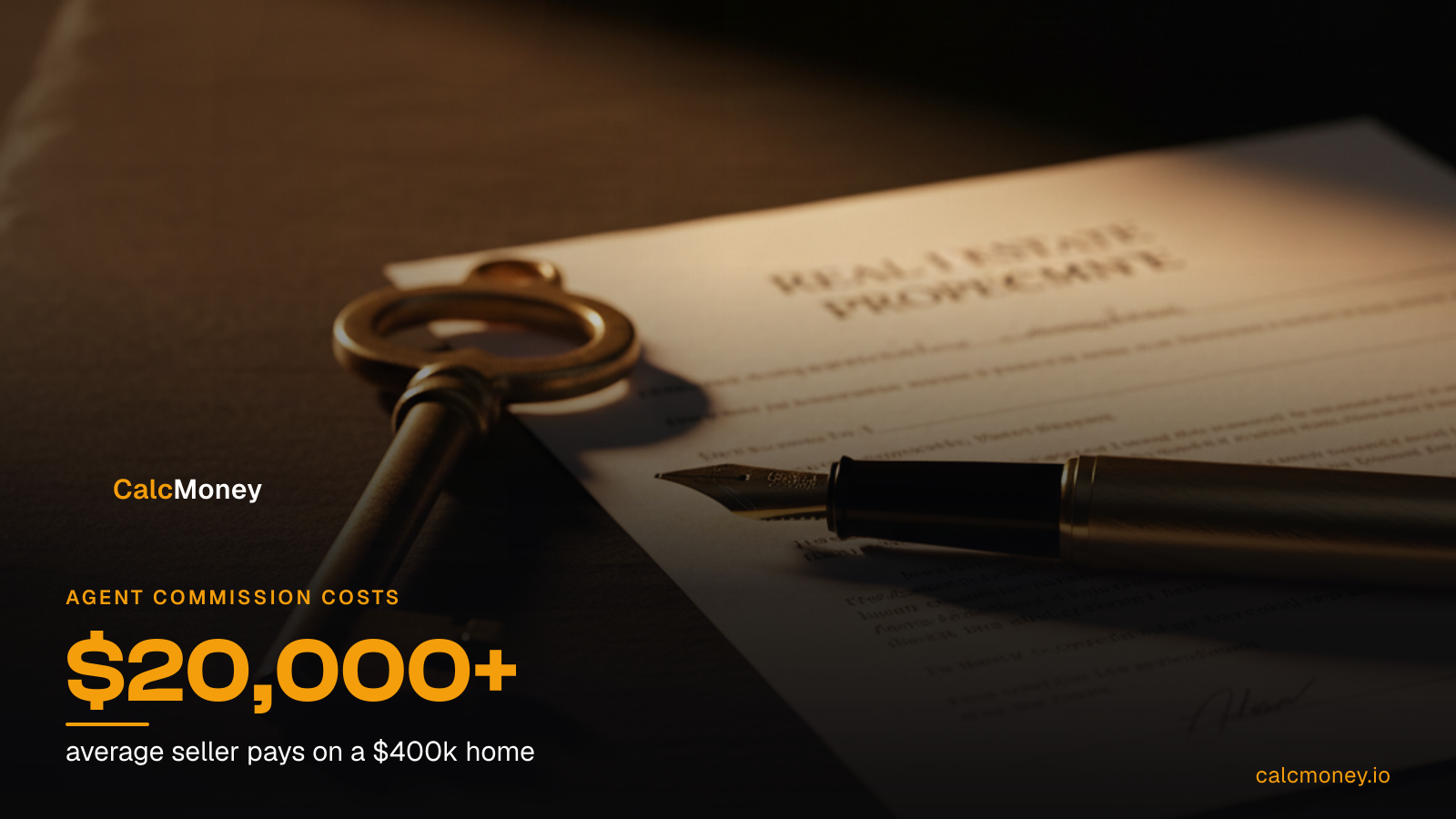
- The standard commission rate of 5% to 6% costs a seller $27,500 to $33,000 on a $550,000 home. Most sellers accept this without a single counter.
- Accepting the first rate quoted without negotiating costs the average seller between $5,500 and $8,250 in unnecessary commission on a mid-tier property.
- Calculate gross commission first, then split it by agent side, then compare that figure against the agent's average days-on-market data before you sign anything.
- Tool: Run your net proceeds after commission with the CalcMoney Mortgage Calculator →
Get Pre-Approved TodaySPONSORED
Lock your rate before it moves. Rocket Mortgage pre-approval takes under 10 minutes.
What Real Estate Commission Actually Is
Commission is the fee paid to the real estate agents involved in a transaction. The seller typically pays it. It comes directly out of the sale proceeds at closing.
The fee is calculated as a percentage of the final sale price. That percentage applies to the gross number, not your equity. If your home sells for $600,000 and you owe $320,000, the commission still calculates against the full $600,000.
The total commission is split between the listing agent (your agent) and the buyer's agent. Historically, a 50/50 split was standard. That split is negotiable and increasingly varied following the 2024 NAR settlement, which changed how buyer's agent compensation is disclosed and agreed upon.
The Standard Rate Range in 2025
The national average sits between 5.0% and 5.5% as of 2025, down slightly from the historical 6% norm. Geography affects this. High-volume markets with competitive agent populations, such as Miami, Phoenix, and Atlanta, often produce rates closer to 4.5%. Slower markets or rural areas may still see 5.5% to 6%.
You have every right to negotiate from the first conversation.
The Commission Calculation: Step by Step
The math requires three inputs: sale price, total commission rate, and split structure.
Formula:
Total Commission = Sale Price x Commission Rate
Listing Agent Share = Total Commission x Listing Agent Split %
Buyer's Agent Share = Total Commission x Buyer's Agent Split %
Worked Example 1: Standard Transaction at $480,000
A seller lists a home at $495,000. It closes at $480,000. The listing agreement specifies a 5.5% total commission, split evenly at 2.75% per side.
Total Commission: $480,000 x 0.055 = $26,400
Listing Agent Share: $26,400 x 0.50 = $13,200
Buyer's Agent Share: $26,400 x 0.50 = $13,200
Net proceeds before other closing costs: $480,000 minus $26,400 = $453,600.
That $26,400 represents 5.5 weeks of gross income for the median US household. It leaves the transaction in approximately three to four hours of paperwork and a few dozen showings.
Worked Example 2: Negotiated Rate at $480,000
Same property. Same sale price. The seller negotiates the total commission to 4.5%, with the listing side accepting 2.0% and the buyer's side receiving 2.5%.
Total Commission: $480,000 x 0.045 = $21,600
Listing Agent Share: $21,600 x (2.0 / 4.5) = $9,600
Buyer's Agent Share: $21,600 x (2.5 / 4.5) = $12,000
Net proceeds before other closing costs: $480,000 minus $21,600 = $458,400.
The seller retained an additional $4,800 by negotiating one percentage point off the listing side. That figure covers roughly four months of average US car payments or a full property tax cycle in many mid-tier markets.
Where the Commission Split Goes
Understanding who receives what gives you a more precise negotiating position.
The listing agent does not pocket the full listing-side commission. They pay a portion to their brokerage. A newer agent at a national franchise may keep only 50% to 60% of their side. An experienced agent at an independent brokerage may keep 80% to 90%.
This matters because a seasoned independent agent often has more flexibility to reduce their rate. Their per-transaction margin is higher even at a lower commission rate. An agent early in their career at a high-split brokerage has less room to move.
Ask the agent directly: what percentage of the commission do you retain after brokerage fees? It is a professional question. Any serious agent will answer it.
The Buyer's Agent Side After the NAR Settlement
The August 2024 NAR settlement restructured how buyer's agent compensation works. Sellers no longer automatically offer buyer's agent compensation through the MLS. Buyers must now negotiate compensation with their own agent through a written buyer representation agreement.
In practice, sellers still frequently offer buyer's agent compensation to attract more buyers. But the amount is now more explicitly negotiated and disclosed. Sellers who offer a below-market buyer's agent rate risk a smaller buyer pool. The practical floor in most markets sits around 2.0% to 2.5% for the buyer's side.
Factor this into your total commission budget. You may reduce the listing side more aggressively while maintaining a competitive buyer's agent offer.
How to Negotiate Commission Effectively
Negotiation works best before you sign a listing agreement. Leverage disappears the moment you sign.
Know Your Market Data First
Agents who consistently close properties in 15 to 20 days in your zip code generate demonstrably more value than agents averaging 45 to 60 days. Pull this data before your first conversation. Zillow, Redfin, and your county recorder's office all surface days-on-market by agent or brokerage.
An agent with a 14-day average DOM and a 98.5% list-to-sale price ratio earns a stronger rate argument than one averaging 52 days and 94.2%. You can make the case for a higher rate with a proven performer. You can make the case for a lower rate with everyone else.
Specific Negotiation Scenarios
Scenario 1: High-value property. Commission rates compress naturally above $1,000,000. A 1% reduction on a $1,200,000 home saves $12,000. The dollar volume still represents a high-income transaction for the agent even at 4.5%. Most experienced agents in luxury segments expect a rate conversation.
Scenario 2: Seller also buying. If the same agent represents you in a simultaneous purchase, offer them both transactions in exchange for a reduced listing rate. The combined commission on two transactions, even at 4.0% on the sell side, often exceeds what they would earn on either deal alone.
Scenario 3: Competitive listing presentation. Request formal listing presentations from three agents. Tell each agent you are interviewing multiple candidates. This alone produces rate flexibility. Agents competing for a listing frequently move 0.25% to 0.5% without further prompting.
Scenario 4: Flat-fee or limited-service model. Flat-fee MLS services list your property on the MLS for a one-time fee between $300 and $800. You handle showings, negotiations, and paperwork. You still offer buyer's agent compensation, typically 2.5%. This path requires significant time investment and works best for sellers with real estate transaction experience.
Commission as a Percentage of Equity, Not Price
Most sellers think about commission as a percentage of sale price. The more accurate frame is commission as a percentage of actual equity.
Consider a seller with $130,000 in equity on a $480,000 home. A $21,600 commission (4.5%) represents 16.6% of their equity. A $26,400 commission (5.5%) represents 20.3% of their equity.
The rate difference of one percentage point becomes a difference of 3.7 percentage points of equity extracted. That reframe changes how seriously most sellers approach the negotiation.
What Commission Does Not Cover
Commission does not include closing costs, transfer taxes, title insurance, attorney fees, or seller concessions. In most markets, total seller-side closing costs run an additional 1.0% to 3.0% of the sale price on top of commission.
On a $480,000 sale with a 5.0% commission and 2.0% in closing costs, total costs at closing reach $33,600. Net proceeds drop to $446,400 before your remaining mortgage balance.
Model the full number before you price the property or accept any offer.
Run Your Own Numbers Before You List
The commission calculation is simple arithmetic. The negotiation depends on knowing that arithmetic precisely before any agent conversation.
Pull three listing presentations. Know the market DOM data. Calculate your equity-based commission cost, not just the headline percentage. Model buyer's agent compensation separately from listing agent compensation.
The CalcMoney Mortgage Calculator lets you input your sale price, commission rate, remaining mortgage balance, and estimated closing costs to see your projected net proceeds in real time. Run the scenario at 5.5%. Run it again at 4.5%. The difference will tell you exactly how hard to negotiate.
Results are estimates for informational purposes only. Consult a licensed financial professional before making financial decisions.
You Might Also Like
- How to Calculate Real Estate ROI Over 10 Years (And Why Most Investors Get It Wrong)
- 1031 Exchange Timeline and Replacement Rules: The Exact Calculations You Need
- How to Calculate After-Repair Value on a Fixer-Upper (And Why Most Investors Get It Wrong)
Put These Numbers to Work
Open a Fidelity brokerage account. $0 commissions, no account minimums, fractional shares available.
Affiliated. We may earn a commission.
Related Guides


Free Tools
Run the actual numbers
Stop estimating. Plug in your numbers and get a precise answer in seconds. Free, no signup required.
Open the Mortgage Calculator