Key Takeaways
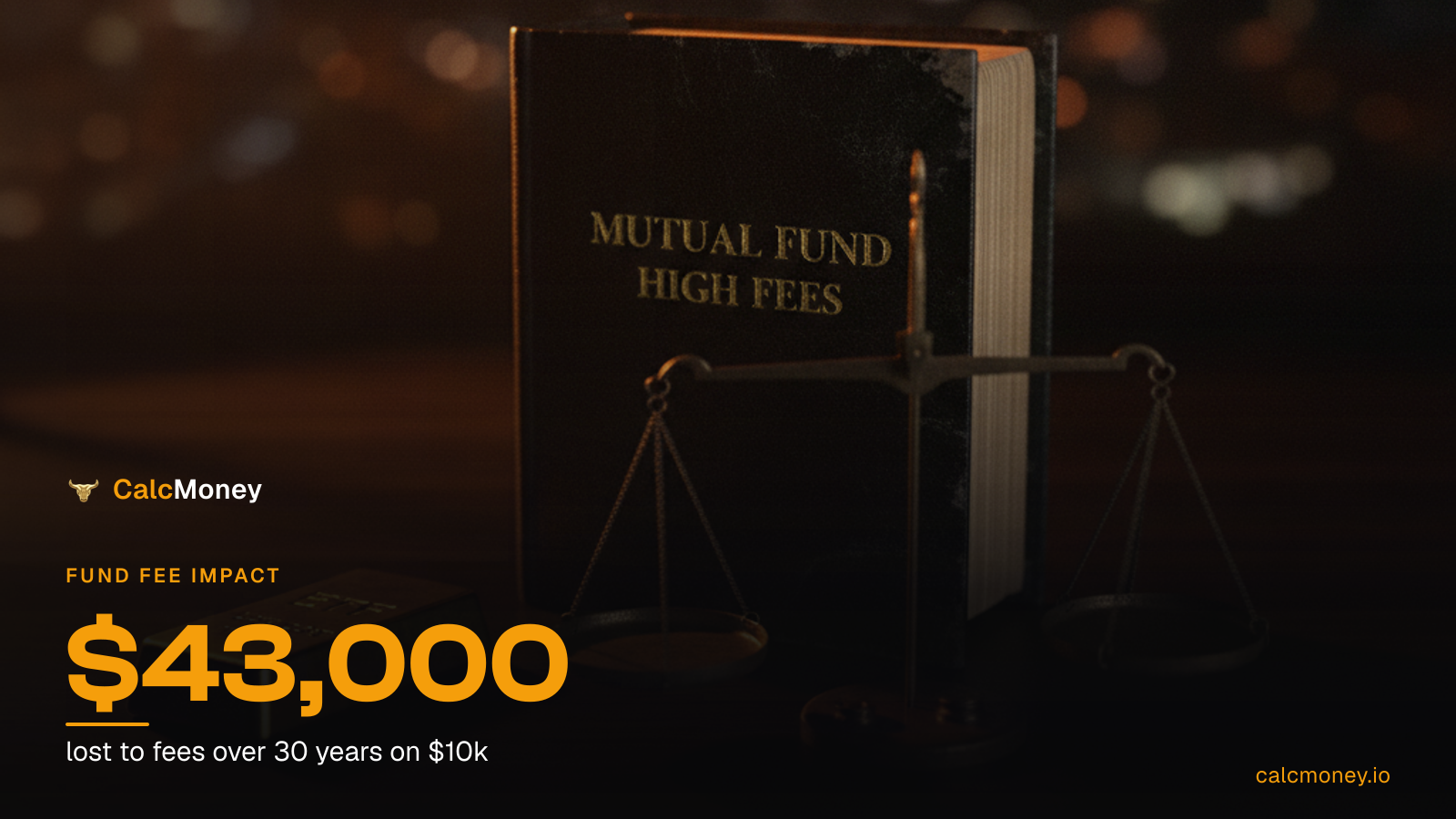
- The average actively managed mutual fund carries a 0.68% expense ratio. The average equity ETF charges 0.16%. On a $500,000 portfolio, that gap costs $2,600 per year before compounding.
- Investors holding mutual funds in taxable accounts often absorb capital gains distributions they never triggered. That tax drag can reduce annualized after-tax returns by 0.5% to 1.2% per year.
- Calculate total cost of ownership by adding expense ratio, transaction costs, bid-ask spread, and estimated annual tax drag before comparing any two funds.
- Tool: Run your fund cost comparison now →
Put Your Money to WorkSPONSORED
Betterment builds and rebalances your portfolio automatically. No guesswork.
The Expense Ratio Is Not the Whole Bill
The expense ratio is the number fund companies advertise. It doesn't represent your actual return.
Total cost of ownership for any fund position includes five components:
- Expense ratio - the annual management fee, expressed as a percentage of assets
- Transaction costs - commissions or load fees paid at entry and exit
- Bid-ask spread - the hidden cost of buying or selling ETF shares on an exchange
- Tax drag - capital gains distributions that generate a tax liability regardless of your actions
- Cash drag - the performance penalty from holding uninvested cash, common in mutual funds awaiting redemptions
Most investor comparisons stop at component one. The real cost picture requires all five.
How to Calculate Expense Ratio Impact Over Time
The expense ratio compounds silently against your balance each year. The formula is straightforward.
After-fee value = Initial investment × ((1 + gross return - expense ratio) ^ years)
Consider two scenarios with identical $250,000 starting balances and an assumed 8% gross annual return over 20 years.
Scenario A: Actively managed mutual fund at 0.82% expense ratio
$250,000 × ((1 + 0.08 - 0.0082) ^ 20) = $250,000 × (1.0718 ^ 20) = $250,000 × 3.966 = $991,500
Scenario B: Broad-market ETF at 0.03% expense ratio
$250,000 × ((1 + 0.08 - 0.0003) ^ 20) = $250,000 × (1.0797 ^ 20) = $250,000 × 4.607 = $1,151,750
The difference: $160,250 over 20 years on a single $250,000 position. That represents roughly four years of retirement spending for many households.
Transaction Costs: Load Funds vs. No-Load ETFs
Many mutual funds still charge sales loads. Front-end loads typically run between 3% and 5.75%. A 5% front-end load on a $100,000 investment means only $95,000 enters the market on day one.
That $5,000 deficit must be recovered before you earn a single dollar of net gain.
At 7% annual return, recovering a 5% front-end load takes approximately 8.5 months. At major brokerages (Fidelity, Schwab, Vanguard), ETF purchases now carry $0 commissions. The transaction cost advantage for ETFs in taxable accounts is substantial.
No-Transaction-Fee Mutual Funds Are Not the Same as No Cost
Many platforms offer NTF mutual fund programs. These funds pay the brokerage a distribution fee, typically 0.25% to 0.40% annually. That fee is embedded in the expense ratio. The investor pays it regardless.
Calling something "no transaction fee" describes the purchase mechanics. It does not describe the cost structure.
Bid-Ask Spread: The ETF Cost Mutual Funds Do Not Have
ETFs trade on exchanges like stocks. Every purchase or sale crosses a spread between the bid price (what a buyer will pay) and the ask price (what a seller will accept).
For highly liquid ETFs like SPY or IVV, the spread is typically $0.01 on a $500+ share price, representing roughly 0.002%. Immaterial.
For thinly traded sector or niche ETFs, spreads can reach 0.10% to 0.50% per trade. On a $200,000 position, a 0.20% spread costs $400 per round trip.
If you rebalance quarterly, that spread costs $1,600 per year on a $200,000 position before any other fees. Mutual funds price at NAV once daily. Spreads do not apply.
The practical rule: For frequent traders or large positions in illiquid ETFs, check the average spread before assuming ETFs are cheaper.
Tax Drag: The Cost That Hits Mutual Fund Holders Hardest
This is where mutual fund costs diverge most sharply from ETFs in taxable accounts.
Mutual funds pool investor capital. When large investors redeem shares, the fund manager must sell holdings to raise cash. Those sales generate realized capital gains. The fund distributes those gains to all remaining shareholders, including shareholders who never sold anything.
In 2023, several large active equity funds distributed capital gains exceeding 8% of NAV. A shareholder with $300,000 in such a fund received a $24,000 taxable distribution. At a 20% federal long-term capital gains rate, that is a $4,800 tax bill on paper gains the investor did not realize and may not have wanted to realize.
ETFs use an in-kind redemption mechanism. Authorized participants exchange ETF shares for the underlying basket of securities. This process does not trigger a taxable event inside the fund. Most equity ETFs distribute zero capital gains in a given year.
Calculating Annual Tax Drag
Estimated annual tax drag = capital gains distribution rate × marginal capital gains tax rate
For a mutual fund distributing 4% of NAV annually to an investor in the 23.8% bracket (20% federal rate plus 3.8% net investment income tax):
Tax drag = 4% × 23.8% = 0.952% of assets per year
On a $400,000 position, that is $3,808 in annual taxes the investor did not choose to incur.
Add that to the expense ratio differential and the total annual cost gap between an actively managed mutual fund and a comparable ETF can exceed 1.5% to 2.0% per year. Over a decade, that gap at $400,000 with a 7% gross return compounds to more than $120,000.
Worked Example: Full Cost Comparison on a $500,000 Portfolio
Investor profile: $500,000 in a taxable brokerage account. Holding a large-cap blend mutual fund versus a large-cap blend ETF. Rebalances once per year. Federal tax rate: 23.8% on long-term gains.
Mutual fund (actively managed large-cap blend)
- Expense ratio: 0.75%
- Annual cost: $3,750
- Transaction cost: $0 (NTF platform, but distribution fee embedded)
- Tax drag: 3.2% distribution × 23.8% = 0.762%, or $3,810
- Total annual cost: $7,560
ETF (large-cap blend index)
- Expense ratio: 0.03%
- Annual cost: $150
- Bid-ask spread (one annual rebalance, 0.002%): $10
- Tax drag: near-zero distributions
- Total annual cost: $160
Annual difference: $7,400
Over 15 years, with reinvestment and compounding at 7% gross return, that $7,400 annual difference compounds to approximately $183,000 in additional wealth retained.
When Mutual Funds Still Make Sense
ETFs win on cost in most taxable account scenarios. The calculus shifts in certain situations.
Tax-advantaged accounts (401k, IRA): Tax drag is irrelevant inside a Roth or traditional IRA. If your 401k plan offers only institutional-share mutual funds with expense ratios below 0.10%, the ETF cost advantage narrows significantly.
Fractional investing requirements: Mutual funds allow exact dollar investments. ETFs trade in whole shares unless your brokerage offers fractional share trading. For automatic monthly contributions of irregular amounts, mutual funds can be operationally simpler.
Active management in inefficient markets: In some categories (small-cap international, frontier markets, certain fixed income niches), active management with strong track records has historically justified higher fees. The math still requires verification on a net-of-fee, after-tax basis.
Defined-benefit pension plans and institutional accounts: These operate under different tax and operational constraints. The retail comparison does not apply directly.
Run the Numbers on Your Actual Holdings
The analysis above uses representative averages. Your funds carry specific expense ratios, specific distribution histories, and specific spread characteristics.
The correct approach is to pull the exact numbers from each fund's prospectus and apply them to your actual account size, tax rate, and time horizon.
CalcMoney's investment calculator lets you input actual expense ratios, estimated annual distributions, and tax rates. It outputs after-tax, after-fee projected values for both structures side by side. The gap in your specific situation may be larger or smaller than the examples above. Either way, you will know the actual number before making a decision.
Calculate the real cost difference for your portfolio →Results are estimates for informational purposes only. Consult a licensed financial professional before making financial decisions.
You Might Also Like
- How to Calculate Dollar-Cost Averaging Returns vs Lump Sum Investing
- How to Calculate Opportunity Cost in Any Financial Decision
- Bond Duration Explained: How to Measure and Manage Interest Rate Risk
The difference between comparing expense ratios and comparing total cost of ownership is the difference between a rough estimate and a financial decision. Use the right calculation.
Put These Numbers to Work
Open a Fidelity brokerage account. $0 commissions, no account minimums, fractional shares available.
Affiliated. We may earn a commission.
Related Guides



Free Tools
Run the actual numbers
Stop estimating. Plug in your numbers and get a precise answer in seconds. Free, no signup required.
Open the Investment Return Calculator